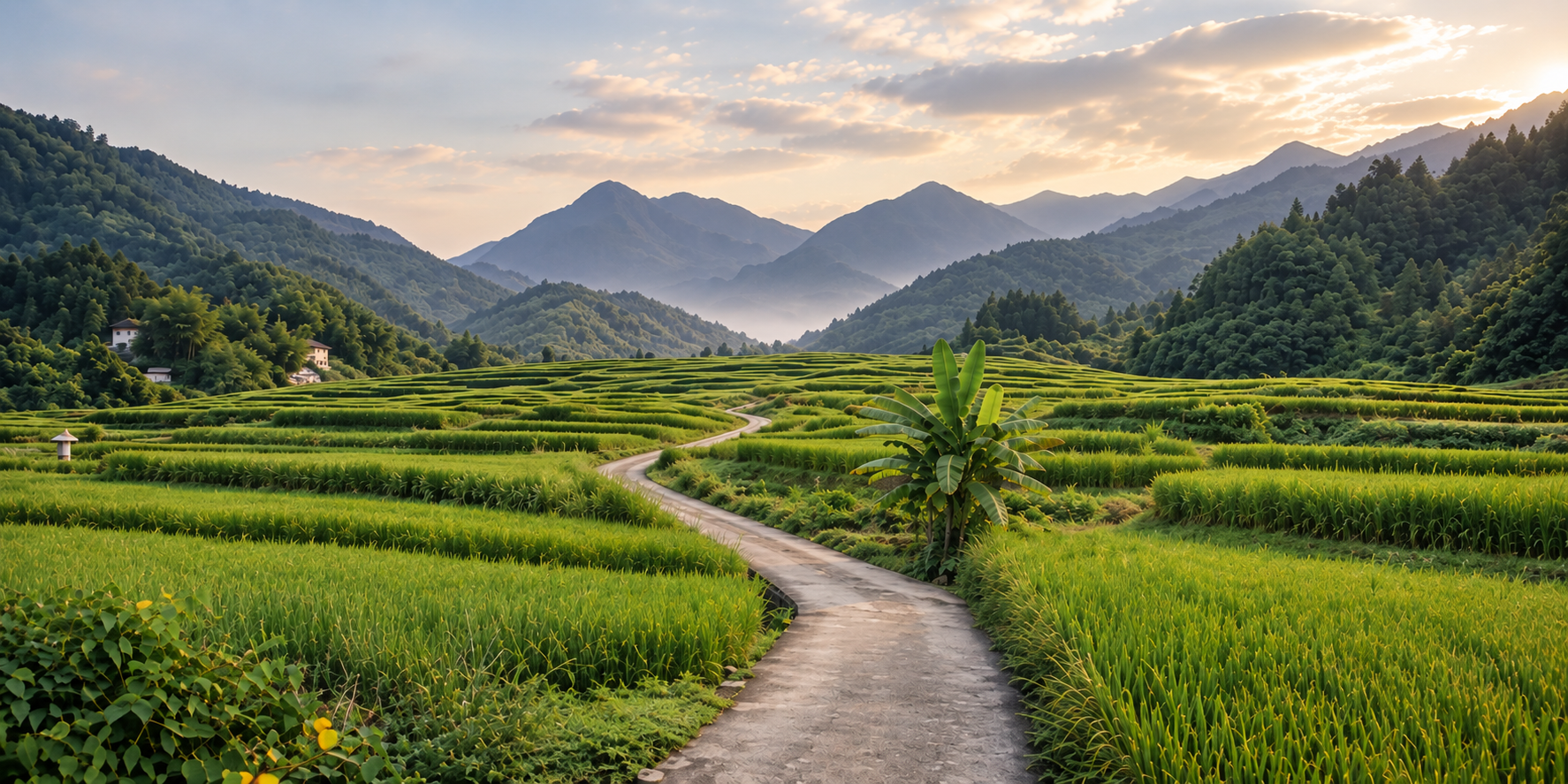
Before Nepal’s mountain trails became trekking routes, they were simply the ways people moved through the Himalayas — between villages and markets, across passes, and along the old trading routes that carried salt south from Tibet and grain north from the plains.
Our ride has something of that older Nepal about it. We aren’t following a famous trekking trail or riding towards a particular peak. For four days we ride the backroads from the warrior kingdom of Gorkha, through Sundar Bazar and Borletar to the lakes of Begnas and Rupa, before finally rolling into Pokhara. There are few tourist sights along the way and almost no other tourists. Instead, this is everyday Nepal: farmers working the terraces, kids walking to school, tea shops, village markets, suspension bridges and little roads winding up and over the hills.
And behind this very human landscape are the Himalayas. Manaslu and the Annapurnas appear above the ridges, rivers carry their snowmelt through the valleys, and towards Pokhara the country opens onto the beautiful lakes of Begnas and Rupa.
It’s challenging riding, with some fairly serious climbs and wonderfully long descents, but we’re not chasing altitude or ticking off Himalayan passes. The pleasure is travelling by bike through a part of rural Nepal that most visitors pass by completely.
Early in the journey we ride beneath Manaslu, whose circuit is sometimes described as the new old Annapurna Circuit — a glimpse of what Himalayan trekking was like before the famous routes became quite so famous. And before we reach Pokhara itself, we come through Rupa and Begnas Lakes, quieter places that retain something of the atmosphere of Pokhara in its earlier, golden years.
In some ways that is the thread running through the whole ride: the Nepal people came to see before everybody came to see Nepal.
This isn’t a high-altitude ride. It is a semi-supported journey through the folds of the Nepalese landscape. Our luggage travels ahead, but on one of the bigger passes the support vehicle has to take the long way around while we take our bikes over the pass. If the larger hills sound a little too enthusiastic, the vehicle can long cut you around with some peaceful flat riding sections and a bit of car time for the small section back on the Kathmandu Pokhara main crazy-busy road.
Nepal is famous for walking through the Himalayas. We think there is something particularly wonderful about riding through them: cool mountain air on your face, dirt beneath the tyres, rice fields falling away below you, and rivers carrying the snowmelt of Manaslu and Annapurna beside the road.
And, of course, there are the downhills and then relaxing in beautiful lakeside POkhara.
If you want more – Pokhara is the perfect place to trek a slice of the Annapurnas and one of the shortest but most view worthy sections – Gandruk Dhampus and PoonHill
Dates
October 21-24 2026
Price: USD
includes airport transfers, meals as stated by the symbols BLD, accommodation, support vehicle, guides / mechanic.
Add USD ???for single supplement.
Group Size: Min 4 Max 8
Cycle days: 4
Cycling level: Challenging
Itinerary
Day 1 Kathmandu
Upon arriving in Kathamndu, you will be met at the airport and transferred to our guesthouse in downtown Kathmandu. Kathmandu is an eclectic medieval Hindu Buddhist pastiche of a city. For those of you who arrive early, jump onto the ancient pilgrim trail to Swayambunath (Monkey Temple) for views over the valley. Fly in a day or two earlier to explore the impressive UNESCO listed Durbar – palaces and surrounds at Patan and Bhaktapur.
Day 2 Kathmandu
B
We warm you up with a short Kathmandu cycle exploratory. It’s a mad city for traffic but the madness is a little more contained within the confines of the old city. Explore the medieval lane-ways, weaving between temples and pagodas on Kathamndu’s car-free Durbar Squares – as you test out your bike. We return the bike to the hotel and continue your city tour on foot and by car.
Day 3 Ghorka
From Kathmandu we drive to the warrior kingdom of Ghorka for an afternoon at the Palace, still intact despite the recent earthquake. Many NGO’s have also made Ghorka their camp as they assess reconstruction and foster community rebuilding.
Ghorka is famous for curved Khukri knives and for the soldiers that wielded them. Ghurkas were recruited by the British for their fearlessness and loyalty and were fondly memorialised by Former Indian Army Chief of Staff Field Marshal Sam Manekshaw, who stated: “If a man says he is not afraid of dying, he is either lying or is a Gurkha.”
Just the spirit we need to the start us off on our mountainous journey to Pokhara.
Ghorka has some stunning hill-country to hike through, and a cosy hillside resort that serves a decent gin and tonic on its Manaslu viewing terrace – or served to you in your comfortable mountain viewing room. It’s an excellent spot to gaze at the Mountain of the Spirit as manaslu translates – a mountain whose different faces you’ll discover on the following day’s ride.
Day 4-6 Sundar Bazaar – Borletar – Begnas- Pokhara
Our three day bike ride to Pokhara starts with a long winding downhill on tarmac before turning into the quiet back roads to Sundar Bazaar (D4), Borletar(5) and Begnas and Rupa Lakes and finally Pokara (D6) with its serene lakes reflecting the famous fishtail Mountain. We follow numerous rivers that carry the snow melt from Annapurna – Mother Goddess Who Feeds the World – to the broad rice fields and farming communities that we ride through.
For most of the ride we are off road on dirt, some shingled rock, patchy tarmac with a few smallish creeks to cross. There are some serious hills to climb, but the views are worth it.
Day 5 and Day 6 our support vehicle becomes merely a luggage transportation service. It cannot follow us over the mountains but will instead go around and meet us at our hotels.
Day 7 Pokhara: the perfect place to unwind in the cafes by its famous Phewa Lake. A short flight (at own expense) takes you back to Kathmandu for your connecting flight back home.
For a longer adventure, consider an extension trek on the Annapurna Circuit. Our 3 night / 4 day tea house trek takes you up to the jewel of Himalayan vistas at Poon Hill.
Includes
Pick up from Kathmandu airport
6 nights twin share accommodation
English speaking guide / leader while on trek and or English speaking guide/ mechanic for smaller groups.
Support vehicle to carry luggage. Note that the vehicle cannot follow us on many of the smaller roads we take and will travel by alternative means to meet us at our guesthouses each night.
All meals outside of Kathamdnu and Pokhara as stated on the itinerary (B = breakfast, L= Lunch, D=dinner)
Transport of bikes back to Kathmandu.
Does not include
Lunch and dinner in Kathmandu or Pokhara
flights – if you fly back from Pokhara to Kathmandu, we can help you book your flight for 135USD.
Travel insurance
Emergency evacuation ( please note that comprehensive travel insurance is a required to join the trip).
Tips and gratuities
Costs arising from unforeseen events outside the control of Bike Aways or our partners.
Bikes – hard tail bikes = 20 USD per day, soft tail bikes = USD 50 per day. Or BYO.
Getting There and Away
Kathmandu is an exciting airport to fly into — particularly if you arrive during daylight hours. On a clear day, sit on the right-hand side of the aircraft flying into Kathmandu for spectacular views along the Himalayas, potentially stretching from Kanchenjunga and Everest in the east towards the Central Himalayas around Kathmandu.
From Hong Kong
Cathay Pacific flies direct from Hong Kong to Kathmandu. This is the successor to the old Dragonair service and remains one of the easiest ways of reaching Nepal from Hong Kong and southern China.
Flights take around 5½ hours, and return fares are typically around HKD 5,800–7,500, although they vary considerably by season and how early you book.
For Hong Kong travellers, the direct flight makes Kathmandu remarkably accessible — no changing planes in Bangkok, Delhi or elsewhere in Asia.
From Bangkok
Thai Airways flies direct between Bangkok Suvarnabhumi and Kathmandu, with flights operating daily.
The flight takes approximately 3½ hours. Return economy fares commonly start around THB 15,000, although promotional fares can be considerably cheaper.
Bangkok remains one of the best gateways for travellers coming from Southeast Asia and Australia. Daytime flights can also give superb Himalayan views: book the right side of the aircraft flying into Kathmandu and the left side flying out.
From Kuala Lumpur
Kuala Lumpur is now one of the best-connected gateways to Kathmandu, particularly for travellers coming from Australia and Southeast Asia.
There are numerous nonstop flights between Kuala Lumpur and Kathmandu, operated by Malaysia Airlines, Batik Air Malaysia, Nepal Airlines and Himalaya Airlines.
The flight takes around 4¾ hours, and the combination of frequent services and generally competitive fares makes KL an excellent alternative to Bangkok or Singapore.
For Australians in particular, it is worth comparing routings through Kuala Lumpur, Singapore and Bangkok before booking.
From Singapore
Singapore is another very convenient gateway, particularly for travellers from Australia and Southeast Asia. Connections through Singapore are generally straightforward, although Kuala Lumpur and Bangkok often offer a greater choice of onward flights and sometimes lower fares.
From India
Delhi is one of Kathmandu’s major international gateways, with multiple flights and several airlines operating the route.
It is particularly useful for travellers combining Nepal with India, or for international travellers whose long-haul flight already takes them through Delhi.
From Europe, Britain and North America
There are currently no nonstop flights from Kathmandu to London, continental Europe, Australia or North America.
The easiest one-stop connections are generally through:
Doha — Qatar Airways
Dubai — flydubai and connecting Emirates services
Istanbul — Turkish Airlines
Delhi — Air India and other Indian carriers
Doha, Dubai and Istanbul are particularly useful for travellers coming from Europe and North America.
From China
Kathmandu also has direct connections with several cities in China, including Guangzhou, Chengdu, Kunming and Lhasa, although routes and frequencies change seasonally.
If you are planning to combine Nepal with Tibet, talk to us before booking flights. Travel in Tibet requires additional permits and arrangements and is best organised as part of the overall itinerary rather than simply treated as a flight stopover.
A note about the views
If your flight operates during daylight and the weather cooperates, the approach to Kathmandu can be one of the great flights in Asia.
Flying into Kathmandu: choose the RIGHT side.
Flying out of Kathmandu: choose the LEFT side.
And keep your camera handy.