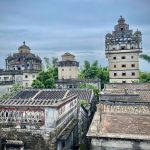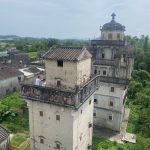
Rui Shi Lou is a mega diaolou that majestically emerges from the horizon—Mughalesque—visible for miles around, yet tucked away in one of the furthest corners of the diaolou clusters. It is far enough from our base in Tangkou that we are hungry for lunch by the time we see its grand dome and surrounding cupolas rising above its protective bamboo skirt.
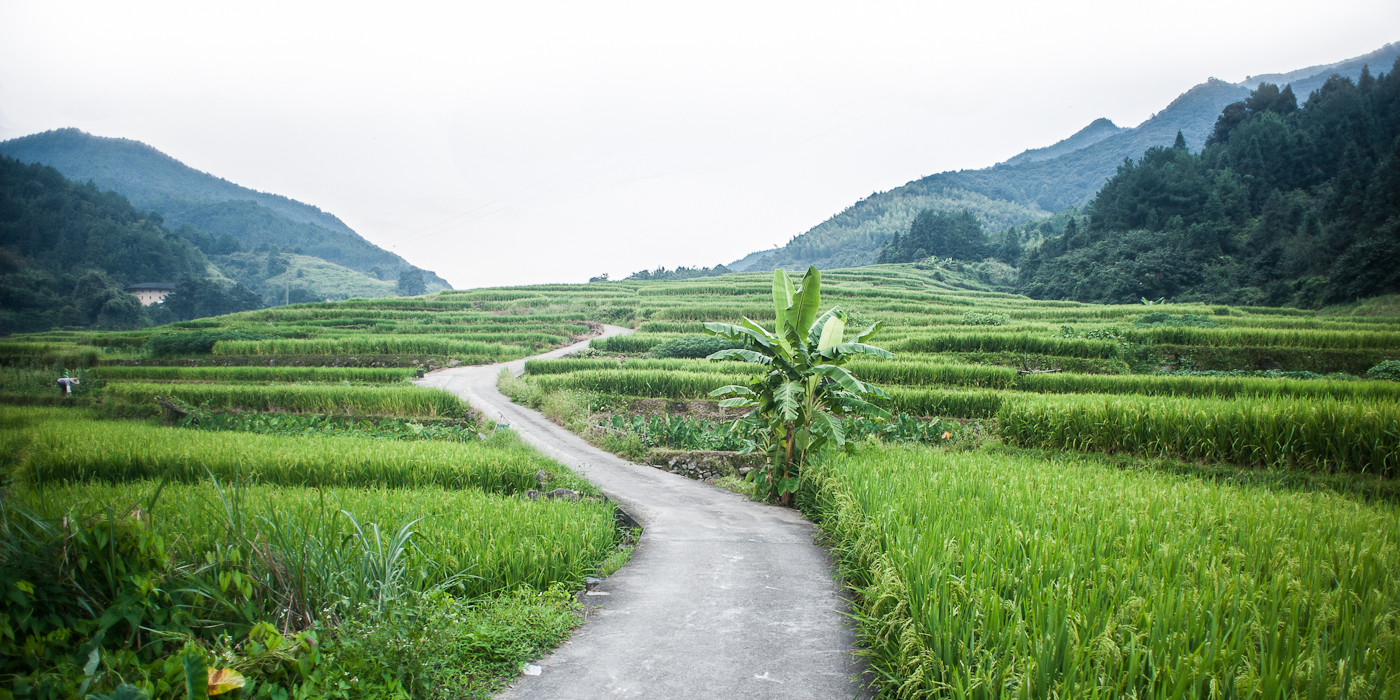
There are 1,800 diaolou still standing, from about 3,000, yet Rui Shi has a majesty amongst them all. It looks like an Indian palace—or is it an Italianate villa? Its form is fairy tale, its frescoed walls still vivid. The winding country roads leading to it create an anticipation like the ragtag characters in The Wizard of Oz drawing close to the Emerald City—or, in our case, hungry cyclists with the promise of lunch waiting at journey’s end.
Despite being one of the famed diaolou, only the dedicated enthusiasts find their way here—or cyclists who appreciate the journey alongside the Tan River and the schlepp through old Xianggang, an arcaded, grandiose southern Chinese shopfront town that looks as though it has been ravaged by time, patched up for movie sets, only to fade back into its memories.
The rice paddies are luminescent. A hillock gives you a grand view of this fortress of the Huang family, who built a stronghold for their fortune—and a building to show how far they’d come.
Glory was clearly fleeting.
It feels like a folly.
It is a folly.
Rain is threatening and we race the thunderclouds down a narrow alley into the surrounding grid-layout village, parking our bikes beneath the sheltering awning of the home of 黄更年 and his wife, who are already preparing our lunch. (WeChat messaging is a wonderful thing.)
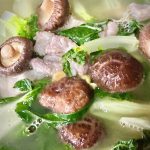
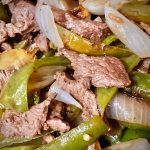
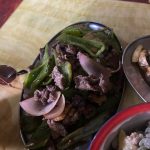
We have a cup of tea and are sent upstairs to enjoy the view while they wok-fry the chicken, heat the fish and winter melon soup, and set out Cantonese-style nongjia cai—beef with winter melon, chenpi-flavoured tofu, and a delicious ginger-infused beef dish that is hoarded on one side of our table. The view is grand. It is a mid-level view of Rui Shi and its sister diaolou—Zheng something—and the little community panic room in the middle, complete with locks and gun slits for shooting bandits but none of the grandeur of Rui Shi or Zheng something.
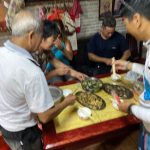
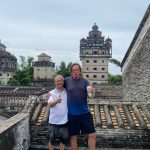
Lunch is hearty and convivial: bones on the table, plenty of hot tea, and self-serve rice from the cooker on the sideboard. Huang is proud—perhaps simply pleased—to have us as guests. He photographs us as a group, then with himself, and finally on the rooftop with views of the drawcard that brings independent-minded travellers to enjoy his homestyle cooking.
He minds our bikes as we haul our stuffed bellies up the alley to Rui Shi Lou.
A great-great-grandson of the grand Huang family clan—who went to the Gold Mountain but made most of their fortune in Hong Kong, establishing a herbal medicine empire—lingers by the ticket desk of this privately owned diaolou-cum-mansion-cum-museum to the glory days of 1925. He hands us a laminated information sheet explaining the rise and fall of the family fortunes, points out the rosewood altar worth several million, and runs his hand over the remarkably solid teak staircase. They spent millions of Republican dollars building it, and today it remains straight and sturdy, without a squeak, carrying us to the ninth floor.
Old trunks, vanities, wooden sit-down toilets, fabulous furniture, mirrors labelled for a Hong Kong glazier, portraits of well-fed children in gingham and dinner suits. It is Gatsby-esque and almost entirely devoid of plastic, synthetics, lifts, carpets, soft furnishings, and all the things we now associate with luxury and comfort. Except for the height, the views, the pediments, the porticoes, and the great circular, halo-like architectural flourishes.
Next time I will bring a cocktail shaker and serve highballs. Perhaps a billowing silk curtain, a few cushions, maybe even a tuxedo jacket and some Brylcreem for my hair before taking a photograph atop this castle, preserving the dream, the fantasy, the world-is-my-oyster optimism—at least as an image.
Or perhaps merely a mirage…